
One inbox, no escalation
A submitted form depends on one inbox and no escalation path
Lead and operational connection
Reduce repetitive handoffs without hiding responsibility. Spectre Stacks builds scoped workflows between forms, email, customer records and business tools, with clear triggers, actions, exceptions and human review where it belongs.
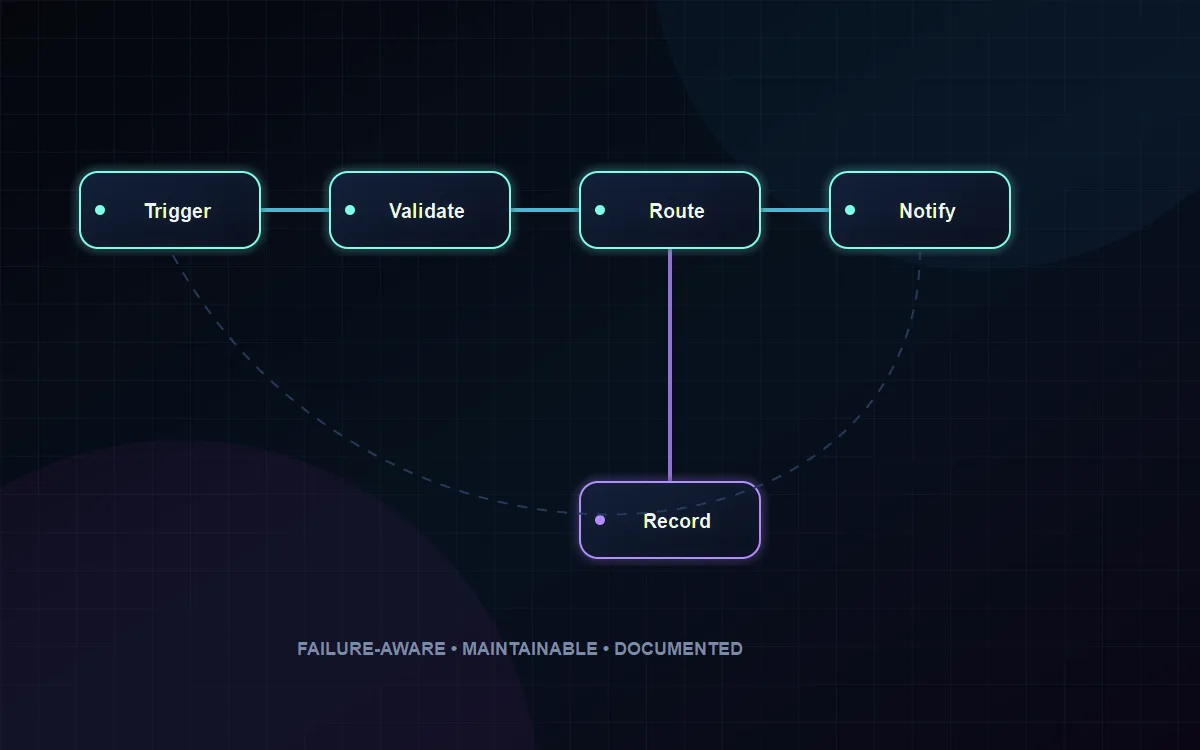
Begin with one useful process
It is what should happen, what information is needed, who is responsible and how a failure will be noticed. A small reliable workflow can be more useful than connecting every available tool.
A submitted form depends on one inbox and no escalation path
Customer records are incomplete or duplicated
Calendars, vendors, and internal owners do not share a reliable status
Automated messages run without error handling or human review
Credentials and integrations belong to a vendor instead of the client
Practical work that can be included
01 / Included
Send the right information to the person responsible for the service, location or request type.
02 / Included
Make receipt and next actions clear without sending duplicate or inappropriate messages.
03 / Included
Connect existing forms and business tools where their available interfaces support the agreed workflow.
04 / Included
Keep decisions that need judgment, authorization or sensitive handling with the right person.
05 / Included
Record what happened, identify unsuccessful steps and provide a way to retry or handle a request manually.
06 / Included
Explain the connected accounts, permissions, trigger rules and maintenance responsibilities.
How the engagement runs
Evidence and ownership
Party Pros demonstrates the importance of connecting quote paths, notifications, operational context, and ongoing management.
View case-study evidence →Automation often touches more than one account. Access should be limited to the work required, with keys or credentials stored appropriately rather than embedded in public pages. Any platform subscription, usage charge or ongoing monitoring obligation is identified separately.
Questions before an integration
We first review the tools, account access and available integration capabilities. A platform replacement is not assumed.
It can help route and organize requests, but qualification, consent-sensitive decisions and unusual cases may need human review. The design should make that boundary visible.
No continuing support term is assumed. Maintenance, platform changes and monitoring are covered by the agreed project or ongoing arrangement.
Not always. The right destination depends on lead volume, team process, reporting needs, and what can be maintained reliably.
Start with the repeated handoff
Describe what is being copied, missed or delayed, and which systems are involved. We can then discuss a contained workflow with clear acceptance checks.