
Spectre Insights
What to prepare before commissioning a service-business website
A useful website brief starts with the business, the customer and the next action—not a list of favorite colors.
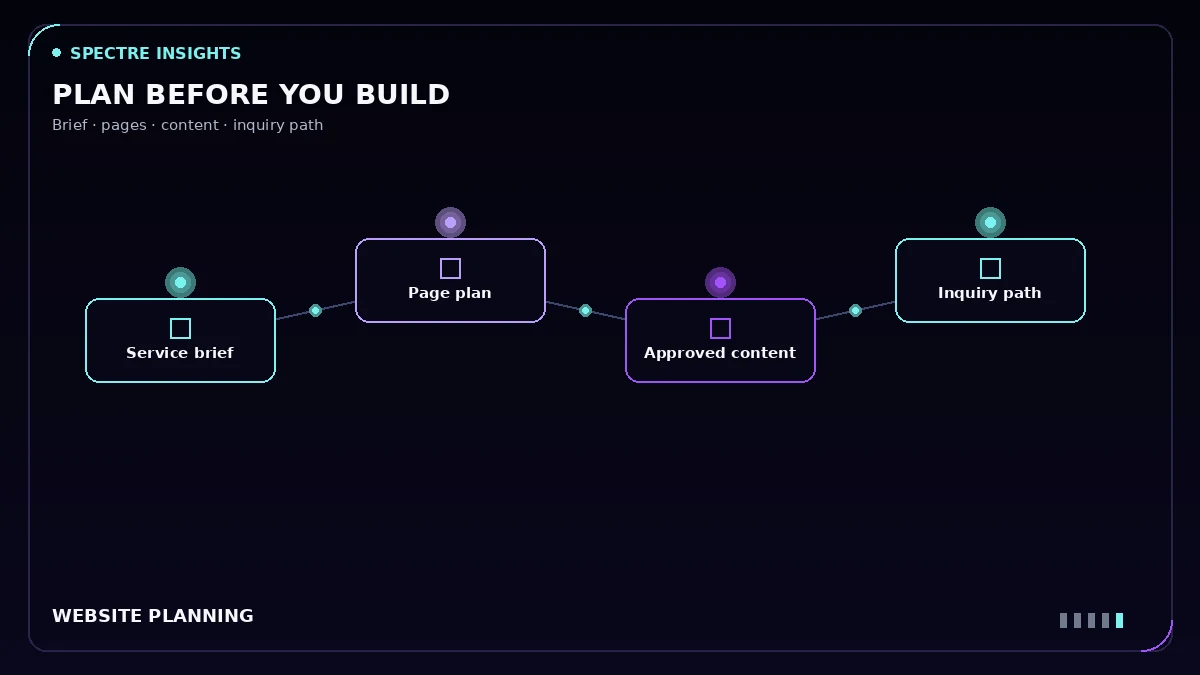
Before commissioning a website, prepare a clear description of your services, who you serve, what customers need to know and how they should contact you. You do not need every paragraph or photograph finished, but you do need enough information to distinguish a useful website from a collection of attractive pages.
A good brief reduces assumptions. It also makes quotes easier to compare because the design, content, functionality and handoff are visible parts of the scope.
Start with the job the website must do
Write one practical sentence: “The website should help this customer understand this service and take this next step.” For example, a property-care business may need visitors to compare services and request an estimate. A consultant may need to explain a specialist offer and receive a project inquiry.
This is a planning example, not a requirement that every website use the same conversion path. A telephone call, a form, an appointment request and an online purchase involve different content and functionality.
Describe the business before the pages
List the services you actually provide, important exclusions and the areas you genuinely serve. Note the questions a customer commonly asks before hiring you. Gather accurate contact details and identify who will approve the public copy.
These details help determine whether the site needs one service page or several. Different page titles are not enough to justify duplicate pages; each page should have a useful purpose for the visitor.
Separate design references from requirements
Design references are helpful when they explain a preference: spacious typography, strong project imagery, clear mobile navigation or a restrained color system. “Make it like this competitor” is less useful when it does not identify the feature you value.
Ask the designer to distinguish the visual direction from the final page structure. A layout should accommodate your real services and content, not force your business into another company’s presentation.
Decide who supplies the content
A website proposal should say who writes, edits, supplies and approves each type of material. This includes service descriptions, biographies, project images, logos, testimonials and policy information.
Only use material you have permission to publish. Client statements should retain their meaning and context. A photograph that looks polished but represents the wrong company is not useful proof.
Not having professional photography ready does not prevent a planning conversation. It does mean the design should use an honest interim treatment rather than invented people, offices or project outcomes.
Define the inquiry path
Decide what information the business needs to respond. Keep the form proportionate: a simple project inquiry should not require a visitor to assemble documents before making contact.
Identify who receives the request and what happens next. Form design is not complete when the fields look good; the accepted submission, notification path and failure behavior also need review.
A new-business inquiry should allow the website field to remain blank. Requiring an existing URL to request a first website creates an avoidable barrier.
Make mobile design an explicit deliverable
Ask to review the page at phone width before approving only a large desktop mockup. Headings, imagery, buttons and forms should have an intentional mobile composition.
Responsive design can preserve the same content while changing its layout. Google uses the mobile version of content for indexing, so deleting useful sections solely to shorten the phone layout is not a neutral choice. Google’s mobile guidance explains this distinction.
Discuss ownership and continuing costs
The quote should identify the domain, hosting, website accounts, content ownership, licensed tools and maintenance arrangement. “You own the website” is incomplete when no one explains which parts are custom deliverables and which are third-party subscriptions.
Ask how routine changes will be made, what the handoff includes and who is responsible after launch. A website project does not have to include advertising management, hosting or indefinite maintenance unless those services are agreed.
A brief you can use
Prepare the following:
- Business name, services and genuine coverage.
- Main audience and the action the website should support.
- Existing website or “new website” status.
- Useful pages, content and integrations.
- Approved brand and project assets.
- Who writes, reviews and approves content.
- Important deadlines, dependencies and budget constraints.
- Account access, ownership and maintenance expectations.
You can refine the brief with the person building the site. The aim is not to complete the entire project before asking for help; it is to give the conversation a dependable starting point.
Illustrative example: a completed one-page brief
| Brief item | Example answer (illustrative) |
|---|---|
| Business and services | A residential cleaning company offering carpet, upholstery and hard-floor cleaning |
| Genuine coverage | The towns the crew actually serves, as listed on the business’s own service-area statement |
| Main audience and next step | Homeowners comparing providers; request a quote by form or call |
| Website status | Existing site; keep the service pages that already bring inquiries |
| Content owner | Owner supplies service details and photos; builder edits for clarity; owner approves |
| Integrations | Quote form notifications to the office inbox; existing analytics property retained |
| Constraints | Launch before the busy season; monthly budget agreed in the proposal |
| Access and care | Owner keeps domain and hosting logins; care plan covers updates and minor edits |
A website is a standalone business investment
Google Ads may eventually bring visitors to the website, but advertising is not a prerequisite for commissioning one. The site can support referrals, existing customers, organic discovery and direct inquiries as well as paid campaigns.
Spectre Stacks provides website design and development as an independent service, including new sites, redesigns and landing pages. Start a project conversation with the information you have, even when there is no current website.