
Spectre Insights
SEO, AEO, and Google Ads: How the Three Acquisition Layers Work Together
Paid search, organic discovery, and answer-engine visibility work best when they share intent, entities, landing pages, and honest conversion definitions.
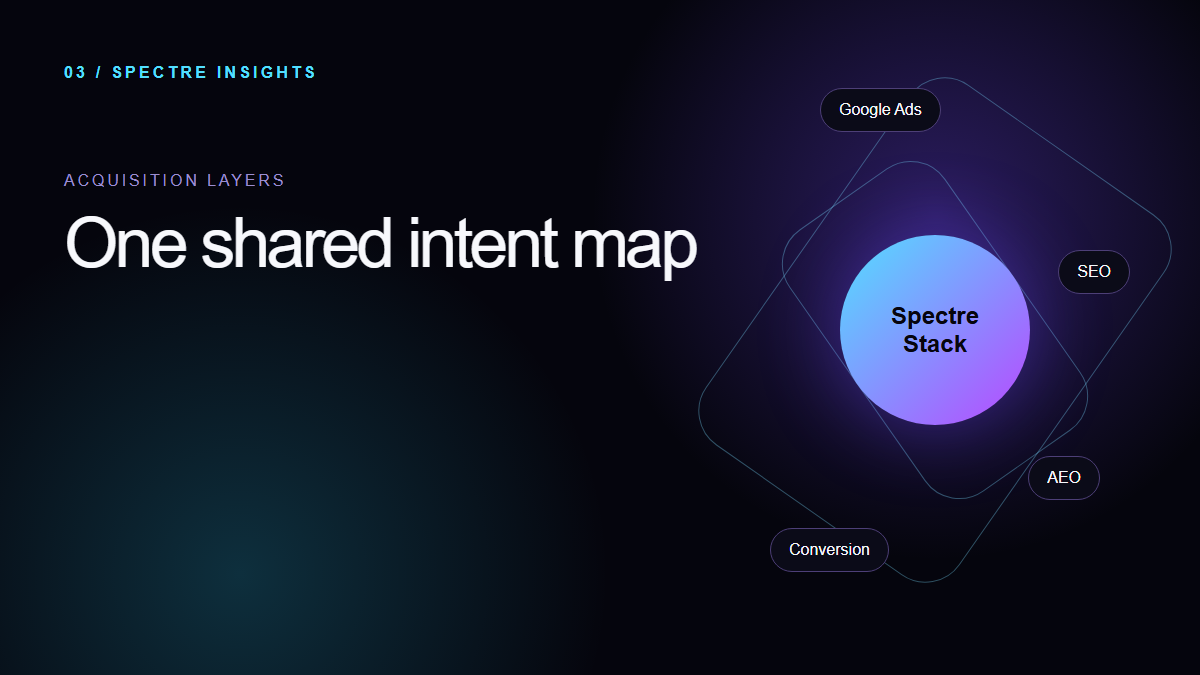
Google Ads, SEO, and AEO are not interchangeable channels. They move at different speeds and earn visibility in different ways, but they should describe the same business, services, locations, offers, and next steps.
Google Ads captures paid demand
Paid search can place an offer in front of people expressing current intent. Campaigns control budgets, targeting, keywords, search terms, ads, assets, and landing destinations. That speed makes Google Ads useful for testing language and demand, but it also makes weak targeting and unreliable conversion signals expensive.
SEO earns organic discovery
SEO connects technical accessibility, useful content, internal linking, authority, and search intent. Service and location pages need distinct purposes. Search engines decide what to crawl, index, and rank, so publication alone does not guarantee visibility.
AEO makes answers and entities clearer
Answer Engine Optimization improves the clarity of direct answers, relationships, definitions, authorship, services, and supporting evidence. It depends on the same trustworthy site and content foundation as SEO; it is not a shortcut that bypasses them.
Shared intent prevents three competing messages
The three channels should agree on the language of the offer and the buyer’s next step. Search-term reports can reveal useful questions and exclusions. Organic query data can expose demand the paid account overlooked. Clear entity and service language can improve both landing-page confidence and answer readiness.
A quarterly language check
Once a quarter, write down four lists: the services you’ll actually fulfill, the places you’ll go, the phrases you will not bid on or chase in search, and the one next step on the page—form, call, or booking. Pull those lists from search-term reports, organic queries, sales objections, and your live service menu—not from a brainstorming doc alone.
Paid search is often the fastest place to learn which phrases waste budget. Organic and answer surfaces need the same clarity so a visitor who arrives without a click still sees the same offer boundaries. When the three layers disagree, the site trains buyers (and machines) on conflicting entities: different service labels, mismatched locations, and CTAs that do not match the ad promise.
Landing pages are the meeting point
Paid and organic visitors may arrive through different paths, but the page still has to answer the question, establish fit, provide evidence, and make conversion understandable on a phone. A campaign landing page may be more focused than an organic service guide, yet both should remain consistent with the brand and actual service.
Paid destination vs organic guide—same truth, different depth
A campaign landing page can be narrower: one offer, one primary proof block, one conversion path, message-matched headlines. An organic service guide can be deeper: process, FAQs, related services, and internal links. Both should still agree on who the offer is for, what happens after contact, and which conversion event counts.
When paid traffic lands on a generic homepage while organic visitors get a careful service page, you are running two businesses in one domain. Fixing that mismatch usually helps measurement and sales response more than another round of bid tweaks. Keep ownership of URLs and tracking IDs documented so either page can be improved without breaking the other layer.
Conversion definitions must be shared
If Google Ads counts one action, analytics counts another, and the business values a third, channel comparisons become misleading. Primary actions, secondary engagement, calls, forms, quote completions, and lead quality need a common interpretation.
Compare the roles before choosing the mix
| Area | What it does | What it does not promise |
|---|---|---|
| Google Ads | Paid participation in relevant advertising opportunities | A budget guarantees profitable inquiries |
| SEO | Improve discovery and understanding through search-friendly content and technical foundations | A published page must rank or a redesign must preserve every position |
| AEO | Make answers, entities and supporting evidence clearer | Special markup guarantees an AI citation |
| Website design and development | Provide a usable, credible destination and customer path | Advertising is required to commission the website |
Google says the established SEO fundamentals continue to apply to its AI features and no additional special requirements are needed to appear there. See Google’s AI-feature guidance.
Choose the work from the business need and available evidence. A website, an organic search engagement and paid acquisition can each be a standalone starting point. Their relationship should be planned without presenting them as inseparable purchases.
What each channel cannot do
Google Ads cannot guarantee profitable demand or repair every website and sales problem. SEO cannot guarantee ranking or immediate traffic. AEO cannot force inclusion in an answer. All three depend on accurate offers, sound pages, useful content, trustworthy measurement, and a business able to respond.
Compare Google Ads management with SEO and AEO, see the acquisition layers in The Spectre Stack, or review the client evidence.
Sensible sequencing when everything feels urgent
If conversion data cannot be trusted, stabilize measurement before reading channel ROI stories. If the page cannot explain the offer on a phone, fix message match before scaling spend. If ownership of domains, ads, or analytics is unclear, resolve access before a migration or vendor change. SEO and AEO work compound on trustworthy pages and entities; they do not replace those prerequisites.
Treat Google Ads as a paced demand instrument, SEO as durable discovery work, and AEO as clarity for answers and machines—connected through shared intent and shared definitions, not through interchangeable budgets.