
Spectre Insights
What a Business Owner Should Actually Own in Their Digital Infrastructure
Domains, advertising, analytics, hosting, email, backups, and documentation should remain legible and recoverable even when trusted vendors operate them.
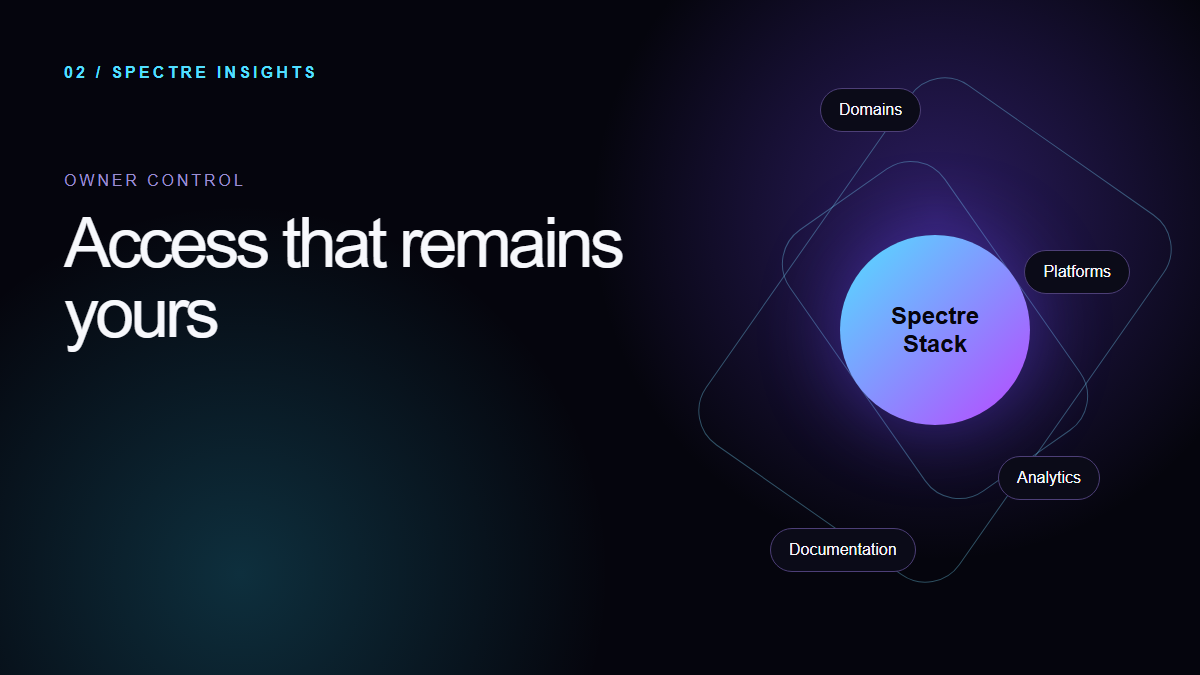
A business owner does not need to perform every technical task, but the business should retain appropriate ownership, billing visibility, recovery access, and documentation for the accounts that control its public presence and customer data.
Vendor access is not the same as owner access
A capable provider may need administrative access to operate campaigns, hosting, analytics, or a website. That access should be granted through the client-controlled account where the platform supports it. The relationship can change without forcing the business to rebuild its identity or negotiate for its own credentials.
Invitation pattern that survives vendor change
Prefer client-owned accounts with vendor users invited at the least privilege that still allows the work. Avoid building the company’s public presence inside a personal inbox or an agency-only login when the platform supports proper ownership. Store recovery emails and phone numbers the business controls. When a relationship ends, removing a user should not remove the property.
Write down who can publish, who can spend, who can export, and who can delete. Those four verbs matter more than a vague “admin” label. If a platform cannot express that separation cleanly, document the workaround and the risk in the access map instead of pretending the risk is gone.
Ownership, access, and licenses are different questions
An administrator login provides access; it does not necessarily prove legal ownership. Likewise, receiving a website does not transfer ownership of every platform, plugin, stock image or reusable tool involved.
Ask who owns the domain, hosting and advertising accounts; who has permission to administer them; which custom deliverables are included; and which third-party licenses must remain active. Record the handoff and renewal responsibilities in the agreement.
A useful ownership checklist includes: account owner, authorized administrator, renewal payer, recovery method, export capability, applicable license and continuing support responsibility. Credentials belong in a secure access arrangement, not in a public portfolio or ordinary inquiry email.
Spectre Stacks’ website design and development service treats those questions as part of the project scope. Advertising management is not a prerequisite for a documented website handoff.
Domains and DNS
The domain registrar account controls renewal and transfer. DNS determines where the website, email, verification records, and many integrations point. The owner should know the registrar, renewal method, nameserver provider, administrative contact, and recovery path.
Hosting and the website platform
Hosting, WordPress or another content system, theme and plugin licenses, deployment access, and staging should be mapped. The business should know who can publish, who can restore a backup, and what happens if the current provider is unavailable.
Google Ads and billing
The client should retain appropriate administrative ownership and billing visibility. Managers can be invited with the permissions required for their role. Campaign history, conversion definitions, audiences, exclusions, and meaningful change records should not disappear with one vendor login.
Offboarding checklist for ads access
Before a vendor departure—or as a quarterly hygiene pass—confirm: the business holds administrative ownership; billing profiles and payment methods are visible to the owner; manager access is inventory-listed; conversion actions and audiences are named in plain language; and a recent change-history export or screenshot set exists for major structural edits. Remove unused managers. Keep at least one owner login that does not depend on the vendor’s SSO.
Campaign excellence is separate from custody. An account can perform well and still be fragile if only one external login can recover it. Custody is part of continuity, not a distrust ritual.
GA4, GTM, and Search Console
Analytics and search properties often become fragmented because each provider creates a new container or property. Owner-controlled access makes it possible to understand which property is authoritative, which tags are active, and where data should continue after a transition.
Email, CRM, and lead records
The email domain, mailboxes, forwarding, CRM, calendar, form destinations, and automation accounts can contain sensitive business and customer information. Access should follow the minimum necessary role, and recovery should not depend on an address controlled by a departing vendor.
Backups and recovery
A backup is useful only when its location, contents, retention, credentials, and restoration path are understood. At least one recovery path should not depend entirely on the same failed system.
Documentation is part of ownership
An access map, provider list, renewal schedule, DNS record, conversion inventory, integration diagram, and change log make ownership practical. The goal is not paperwork for its own sake; it is a faster, safer response when a campaign, form, website, or provider changes.
Explore Infrastructure and Continuity, see how the Foundation layer connects to the rest of the Stack, or discuss an access and recovery review.
Minimum viable access map
A practical one-pager beats an unread wiki. Include: domain registrar and renewal date; DNS host; hosting panel; CMS admin URL; Google Ads CID; GA4 property ID; GTM container ID; Search Console property; form destination; CRM; backup location and last restore test; and the humans who hold owner credentials. Update the map when any provider or primary conversion definition changes.
The point is speed under stress: site down, ads suspended, form silent, or a contractor unreachable. Ownership is the ability to restore service without negotiating for your own keys.