
Spectre Insights
Why Google Ads, Landing Pages, Tracking, and Lead Follow-Up Must Operate as One System
Clicks become business opportunities only when search intent, landing-page message match, conversion tracking, lead routing, and lead-quality feedback work together.
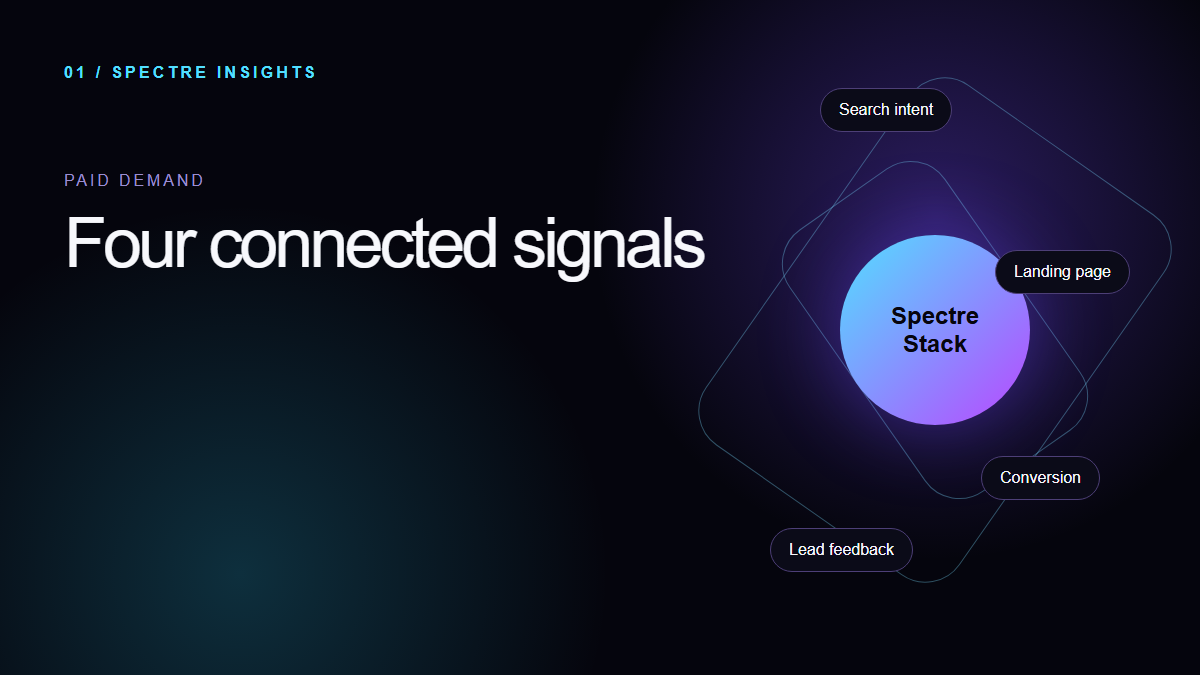
Google Ads can create immediate access to high-intent demand, but a click is only the beginning. The campaign, landing page, conversion signal, and response process must agree on what the visitor wants and what the business will do next.
Clicks are inputs, not outcomes
A campaign can report traffic and conversions while the business receives irrelevant inquiries, duplicate signals, or leads that never reach the right person. Useful management begins with an explicit offer, geography, search intent, and definition of a qualified next step.
Search intent and message match
Campaigns should separate materially different services, locations, and buyer intent. Search terms reveal the language people actually use. Ads and assets promise a specific answer; the landing page must continue that promise rather than resetting the conversation with a generic homepage.
For a regional event-rental company such as Party Pros East Coast, a search for a school field-day rental carries a different need from a corporate casino-night inquiry. Campaign structure and landing content should respect that difference without creating an unmaintainable page for every phrase.
The landing page must support the decision
Mobile hierarchy, evidence, service context, geography, availability expectations, and the form or quote path all influence whether paid attention becomes a credible inquiry. Faster pages help, but speed cannot compensate for an unclear offer or a form that asks the wrong questions.
Landing-page inspection (paid traffic)
Open the real final URL on a phone. Do not rely on the desktop editor preview alone.
Check in this order:
- First screen — Does the headline continue the ad’s promise, or does it restart with a generic brand line?
- Fit and geography — Can a visitor tell who the offer is for and where you serve without hunting?
- Evidence — Is there enough proof to trust the next step (scope, process, constraints)—not empty claims?
- Next step — Is the form or call path visible without sticky obstacles or a scavenger hunt?
- Form questions — Do fields collect what the business needs to respond, without asking for a full proposal up front?
- Success state — After submit, does the visitor get a clear confirmation, and does the owner get the same inquiry?
Speed helps. It does not replace message match or a form that asks the wrong questions.
Tracking must represent the real action
Primary conversions should identify meaningful form submissions, calls, or quote completions. Secondary actions can help diagnose behavior, but they should not be mixed with the actions used for bidding or business reporting. Duplicate events, thank-you pages loaded twice, imported actions, and plugin listeners can make performance appear stronger than it is.
Conversion tracking and analytics should include a controlled test path and a record of what each platform receives.
Controlled test path checklist
Run one intentional conversion and write down what each system shows.
| Step | Pass condition |
|---|---|
| Fill the live form (or place a real test call) | Success page or confirmation appears once |
| Tag / event | One primary conversion fires for that action |
| Analytics (if used) | Same action appears once, with the expected page or event name |
| Ads conversion action | Count moves by one for the primary action only |
| Inbox / CRM / notification | Message arrives with usable fields |
| Secondary actions | May fire for diagnosis; must not be the bidding goal |
If any row disagrees, stop scaling. Fix the chain until the same test produces one authoritative business event and one matching primary signal.
A lead is not complete when the form submits
The inquiry must reach an inbox, CRM, or responsible person with enough context to respond. A customer acknowledgment, internal alert, qualification step, and fallback can matter as much as the form itself. Automation and integrations should make this handoff observable without removing necessary human judgment.
Handoff failure modes
| Break | Symptom | Inspect |
|---|---|---|
| Form success, no mail | “Conversions” continue; owner sees nothing | Form plugin, SMTP, spam folder, webhook |
| Mail arrives, no owner alert | Leads sit until someone checks a shared inbox | Notification rules, routing, on-call coverage |
| Thin context | Owner must re-ask basics the form already could collect | Field list vs response script |
| Duplicate submissions | Same person counted twice; bidding learns noise | Thank-you reload, double listeners, retry behavior |
| After-hours black hole | Night leads go cold | Acknowledgment copy + next-business-day expectation |
Automation should make the handoff observable. It should not hide whether a human can still act on the inquiry.
Lead quality closes the loop
Platform algorithms optimize toward the signals they receive. If every form submission looks equally valuable, irrelevant and qualified inquiries teach the system the same lesson. Regular feedback from the owner or sales process helps determine which queries, offers, locations, pages, and conversion actions deserve the next change.
You can improve the website without hiring ads management—and the reverse
You can hire website work without an ads contract, or keep your current site builder and bring in Google Ads help separately. Just be clear who owns which part and how handoffs work.
If ads are the priority, look at the campaign, the page people land on, how inquiries get handled, and what gets measured. If the website is the priority, start with design, content, build, and launch—and leave ads out of scope until you want them.
A simple inquiry path: someone finds a relevant page, understands the service, sends a real request, the right person gets it, and the business decides what to do. Define and test each step. A broken notification is not the same problem as no search demand.
Explore Google Ads management and website design and development as separate services that can be connected when useful.
Ads cannot repair every problem
Paid media cannot fix an unavailable service, weak offer, slow response, broken website, misleading conversion definition, or sales process that never records outcomes. Sometimes the best account decision is a landing-page repair, tracking correction, or operational change before additional spend.
Start with the Google Ads strategy and management page, review the Party Pros case study, or request an ads and tracking review.